
How AI Answer Engines are Changing How Local Customers Find Your Business

Quick Answer: AI answer engines (like those powering Google's AI Overviews, ChatGPT search, and voice assistants) no longer just point customers to a list of websites. They read your business's data, reviews, and response patterns, then recommend a specific provider directly. For local service businesses in 2026, understanding how AI answer engines are changing how local customers find your business is the difference between a full schedule and an empty phone.
🔑 Key Takeaways
- AI answer engines now deliver direct business recommendations, not just search results — your Google Business Profile, reviews, and response speed all feed into these recommendations.
- A response time over 5 minutes is effectively a lost sale in 2026. Hawk Guru delivers lead response in under 5 seconds.
- Businesses with consistent 5-star reviews, accurate listings, and fast follow-up are the ones AI engines cite and recommend.
- The old model (customer Googles → clicks → calls → waits) is being replaced by AI-mediated discovery: the engine picks the winner before the customer even visits your site.
- Automating your Voice AI Receptionist, review collection, and follow-up is no longer optional — it's the infrastructure that makes you visible to AI engines.
- Fragmented tech stacks (Calendly + Mailchimp + Podium + a part-time receptionist) are a liability in an AI-first search world. A unified system wins.
- Local businesses that adapt now will capture the customers that AI engines recommend. Those that don't will become invisible.
What Exactly Is an AI Answer Engine?
An AI answer engine is a system that processes a user's question and returns a direct, confident answer — often naming a specific business, product, or service — instead of a list of links to browse. Google's AI Overviews, Perplexity, ChatGPT's web-browsing mode, and Siri all function this way.
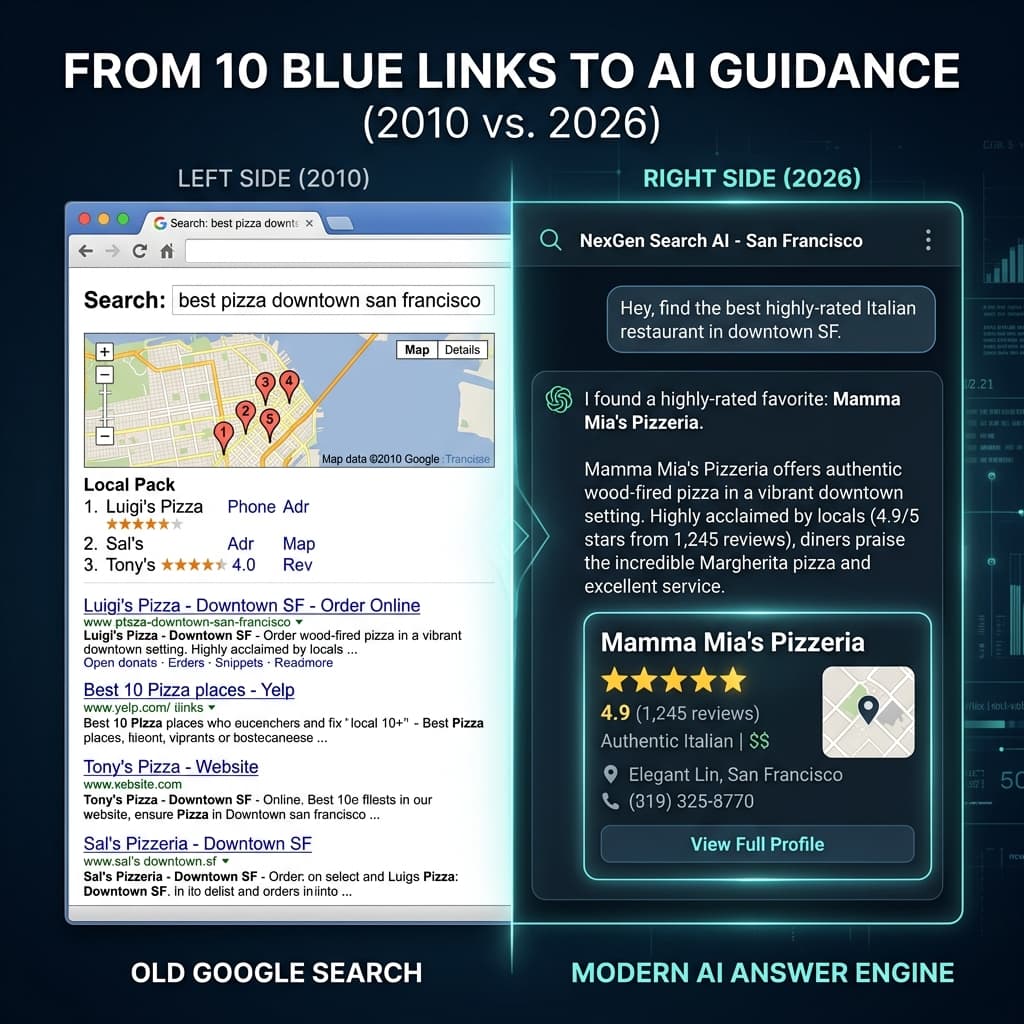
For local service businesses, this is a fundamental shift. When someone asks, "Who's the best HVAC company near me that's available today?" an AI answer engine doesn't show ten blue links. It picks one or two businesses and explains why. The criteria it uses: your review volume and recency, your response speed, your listing accuracy, and the consistency of your online presence.
The practical implication: If your business isn't optimized for how AI answer engines are changing how local customers find your business, you're not just ranking lower — you may not appear at all.
How Did Local Search Work Before, and What Changed?
Before AI answer engines dominated, local search followed a predictable path:
- Customer searches "plumber near me"
- Google returns a map pack and organic results
- Customer clicks 2–3 listings, reads reviews, calls the one that seems best
- Business either answers or misses the call
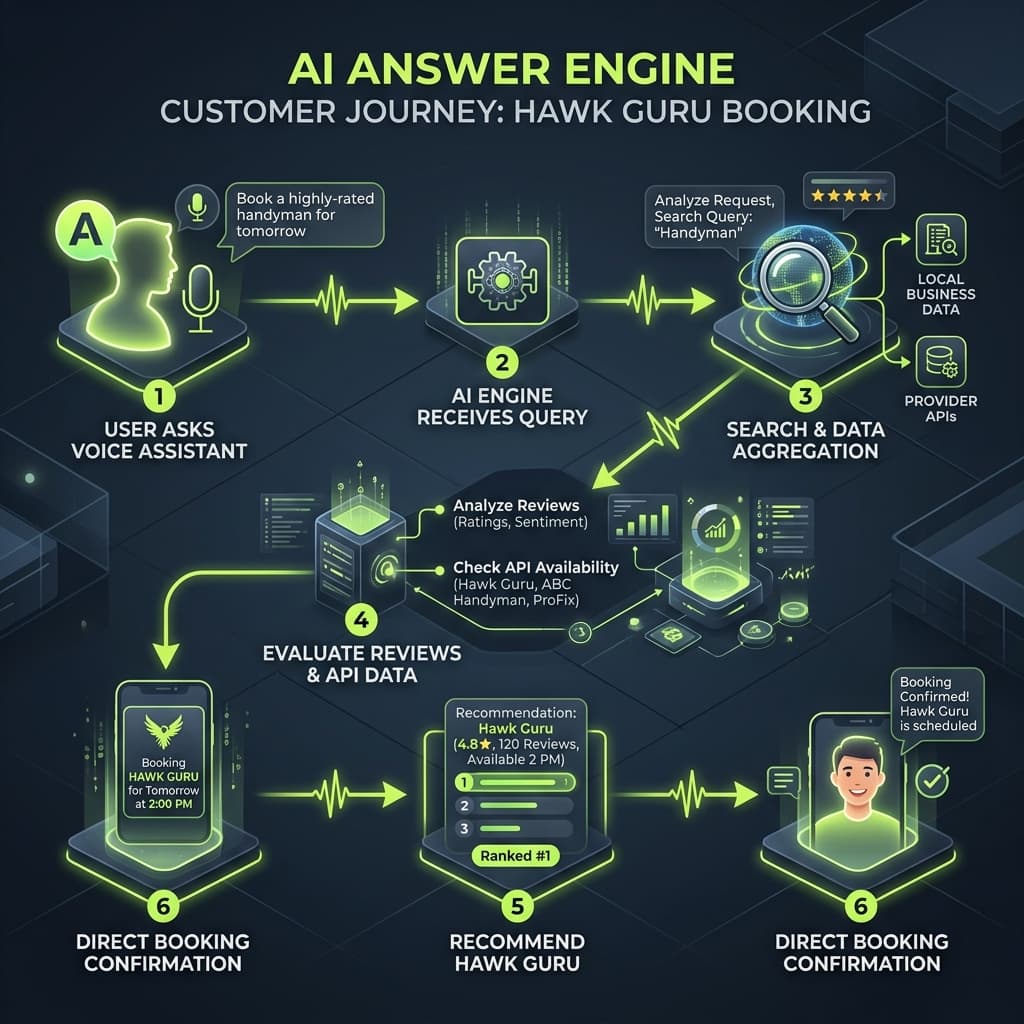
What changed in 2025–2026: AI systems now compress steps 2–4 into a single recommendation. The engine reads your reviews, checks your response patterns (are you fast? do you follow up?), and surfaces your business directly in the answer. The customer may never visit your website.
This shift means your digital reputation and operational speed are now ranking factors — not just for SEO, but for AI visibility.
What Signals Do AI Answer Engines Use to Recommend Local Businesses?
AI answer engines evaluate local businesses on a cluster of signals that overlap with, but go beyond, traditional SEO. Here's what matters most:
| Signal | Why It Matters to AI Engines |
|---|---|
| Review volume & recency | AI engines treat recent 5-star reviews as proof of consistent quality |
| Response speed | Engines increasingly factor in how quickly a business responds to inquiries |
| Listing accuracy | Consistent NAP (Name, Address, Phone) across Google, Yelp, and directories |
| Website structured data | Schema markup helps AI parse your services, hours, and location |
| Booking availability | Businesses with online booking get cited more often in direct-answer results |
| Social proof consistency | Reviews that mention specific services help AI match queries to your business |
The businesses winning AI-driven recommendations right now share one trait: they look reliable to a machine. That means fast responses, clean data, and a steady flow of positive reviews — all of which can be automated.
For a deeper look at automating your Google review pipeline, see Google Reviews Automation: How to Get More 5-Star Reviews on Autopilot in 2026.
How Are AI Answer Engines Changing How Local Customers Find Your Business in Practice?
The change is happening at every stage of the customer journey, and it's accelerating fast.
Discovery is now conversational. A homeowner doesn't type "roof repair Tampa." They ask their phone, "Hey, who can fix my roof this week?" The AI engine pulls from structured data, reviews, and real-time availability to name a specific contractor. If your business isn't set up to feed that engine with clean, current data, you're invisible.
The zero-click problem is real. In many local searches, the customer gets their answer — including a business name and phone number — directly in the AI response. They never click through to a website. This means your website traffic may decline even as your actual inquiries increase, but only if you're the business being cited.
Speed determines who gets cited. AI engines have begun factoring in operational responsiveness. A business that answers calls instantly, follows up on web leads in seconds, and maintains a consistent booking flow signals reliability. A business that lets calls go to voicemail and takes 24 hours to follow up signals the opposite.
This is exactly why speed-to-lead matters so much — and why Hawk Guru's <5-second response time isn't a feature, it's a survival requirement for 2026.
What's the Real Cost of Not Adapting to AI-Driven Local Discovery?
For a scaling service provider or clinic director, the cost isn't abstract. Here's what's actually happening:
- A potential patient asks an AI assistant for a med spa near them. The engine recommends a competitor with 200 recent reviews and instant online booking. Your practice has 40 reviews and a "call during business hours" message.
- An HVAC owner misses 3 calls on a Friday afternoon. Each call was a $400–$800 job. That's $1,200–$2,400 gone in one afternoon — not because the leads didn't exist, but because no one answered.
- A marketing agency pitches a client on "more clicks." The client's competitor is being directly recommended by AI engines. Clicks are irrelevant if the AI never surfaces your client's business.
The math is straightforward. Businesses that stop leaking leads through slow response times and inconsistent data capture a disproportionate share of AI-driven referrals. Those that don't lose ground every week.
How Does a Unified AI System Make Your Business More Visible to Answer Engines?
The fragmented tech stack — Calendly for booking, Mailchimp for email, Podium for reviews, a part-time receptionist for calls — creates data silos. Each tool operates independently, which means your business looks inconsistent to AI engines that are trying to assess reliability.
A unified system solves this by keeping every customer interaction, review request, booking, and follow-up in one place. The result is a business that looks coherent and responsive from the outside — exactly what AI answer engines reward.
Here's the contrast:
The Old Way:
- 5+ separate tools that don't talk to each other
- Missed calls go to voicemail; follow-up happens hours later (if at all)
- Review requests sent manually, inconsistently
- Booking requires back-and-forth phone calls
- Owner spends 20+ hours a week on admin
The Hawk Guru Way (One Operating System):
- Voice AI Receptionist answers every call, 24/7, in under 5 seconds
- Automated follow-up fires within seconds of a missed call or web inquiry
- Review requests go out automatically after every completed job
- Booking is confirmed without human intervention
- Owner reclaims 20 hours a week
For a full breakdown of how one platform replaces the fragmented stack, see Replace Your Tech Stack: How One AI Platform Replaces Your CRM, Phone, Email & More.
What Steps Should Local Businesses Take Right Now?
Adapting to how AI answer engines are changing how local customers find your business doesn't require a complete overhaul overnight. It requires prioritizing the right signals.
- Audit your Google Business Profile.
Ensure your name, address, phone number, hours, and service categories are accurate and complete. Add photos regularly. This is the primary data source AI engines pull from for local recommendations. - Build review velocity.
AI engines weight recency heavily. A business with 10 reviews from 2023 loses to one with 30 reviews from the last 90 days. Automate review requests so every completed job generates a prompt. - Close the response gap.
If your business takes more than 5 minutes to respond to a new inquiry, you're losing the lead — and signaling unreliability to AI systems. An AI lead follow-up system that responds in under 60 seconds changes this immediately. - Implement a Voice AI Receptionist.
Every unanswered call is a missed citation opportunity. AI Voice Agents answer, qualify, and book callers 24/7 — including after hours, when most competitors go dark. - Consolidate your tech stack.
Fragmented tools create fragmented data. A single operating system like Hawk Guru ensures every touchpoint — call, text, booking, review — feeds into one coherent profile that AI engines can read and trust.
FAQ: AI Answer Engines and Local Business Visibility
What is an AI answer engine, and how is it different from a search engine?
A search engine returns a list of links. An AI answer engine reads those sources and delivers a direct answer — often naming a specific business — without requiring the user to click through.
Does my website still matter if AI engines give direct answers?
Yes, but differently. Your website's structured data, schema markup, and content still feed AI engines. However, your Google Business Profile and reviews are often weighted more heavily for local queries.
How does response speed affect AI engine recommendations?
AI engines increasingly factor in operational signals like response time and booking availability. A business that responds to inquiries in seconds and offers instant booking appears more reliable than one that doesn't.
What's the minimum review count needed to appear in AI recommendations?
There's no fixed threshold, but recency and consistency matter more than raw volume. A business with 40 reviews posted in the last 6 months will generally outperform one with 200 reviews from 3 years ago.
Can a small local business (under 10 employees) compete with larger competitors in AI search?
Yes. AI engines reward responsiveness and review quality, not company size. A 3-person HVAC company with fast follow-up and strong recent reviews can outrank a 50-person competitor with slow response times.
What happens when a customer asks a voice assistant for a local business recommendation?
The assistant pulls from Google Business Profile data, structured web content, and review signals to name one or two businesses. If your listing is incomplete or your reviews are stale, you won't be named.
Is optimizing for AI answer engines the same as traditional SEO?
It overlaps but isn't identical. Traditional SEO focuses on ranking in link-based results. AI engine optimization (AEO) focuses on being cited in direct answers — which requires clean data, strong reviews, and operational signals like response speed.
How quickly can a business see results after implementing AI automation?
Most businesses using a unified system like Hawk Guru report measurable improvements in lead capture and booking rates within the first 30 days, primarily because missed calls and slow follow-ups are eliminated immediately.
Does automating reviews violate Google's policies?
Automating the request for reviews (sending a prompt after a job is completed) is within Google's guidelines. Generating fake reviews or incentivizing specific ratings is not. Hawk Guru's system automates compliant review requests only.
What's the biggest mistake local businesses make with AI-driven search?
Treating it like traditional SEO and focusing only on keywords. AI engines care about the full operational picture: how fast you respond, how consistent your reviews are, and whether your business data is accurate everywhere it appears online.
Conclusion: The Businesses AI Engines Recommend Are the Ones That Act Now
How AI answer engines are changing how local customers find your business isn't a future trend — it's the current reality of local search in 2026. The businesses being recommended today share a common profile: fast response times, consistent 5-star reviews, accurate listings, and a unified system that handles every customer touchpoint without dropping the ball.
The burned-out HVAC owner answering calls at dinner, the clinic director whose front desk can't keep up, the agency owner trying to prove ROI beyond clicks — all three face the same underlying problem. Their businesses are invisible to AI engines because the operational signals aren't there.
The fix isn't hiring more staff. It's building the infrastructure that makes your business look reliable to a machine: a Voice AI Receptionist that answers every call, automated follow-up that fires in under 5 seconds, and a review engine that runs on autopilot.
That's what Hawk Guru delivers. Not a collection of tools — a Business Operating System built for the way customers find businesses in 2026.
Ready to become the business AI engines recommend?
Start Your Free Trial →