
The Hidden Cost of Disconnected Tools: Why Smart Businesses Are Consolidating to All-in-One Platforms
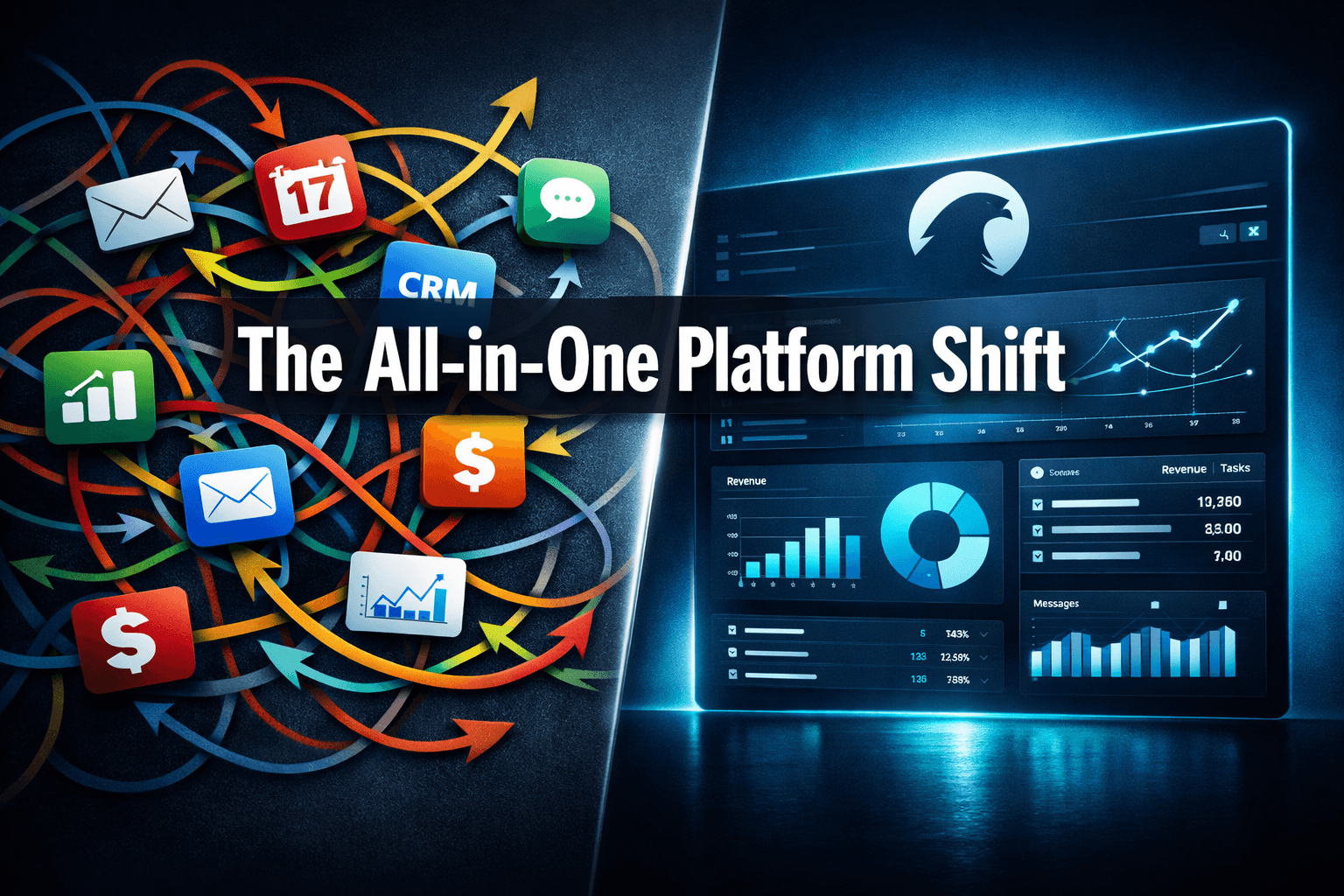
Quick Answer: Businesses running 5 or more separate software tools are quietly bleeding revenue through data gaps, delayed lead responses, and redundant subscription costs. The shift to a unified all-in-one CRM platform — combining marketing automation consolidation, CRM integration, and AI-powered workflows — is how service businesses reduce software costs and scale.
Key Takeaways
- Consolidation beats fragmentation in 2026
- Avg service business pays for 5–10 disconnected tools
- Unified platforms eliminate duplicate data entry
- Recover 20+ hours per week lost to manual tasks
- Lead response speed is the single biggest revenue lever
- A Business Operating System (BOS) replaces CRM + Phone + Email
- Major players (Canva, Shopify, Salesforce) are betting on consolidation
- Fragmented tools make fast lead response nearly impossible
What Is the All-in-One Platform Shift?
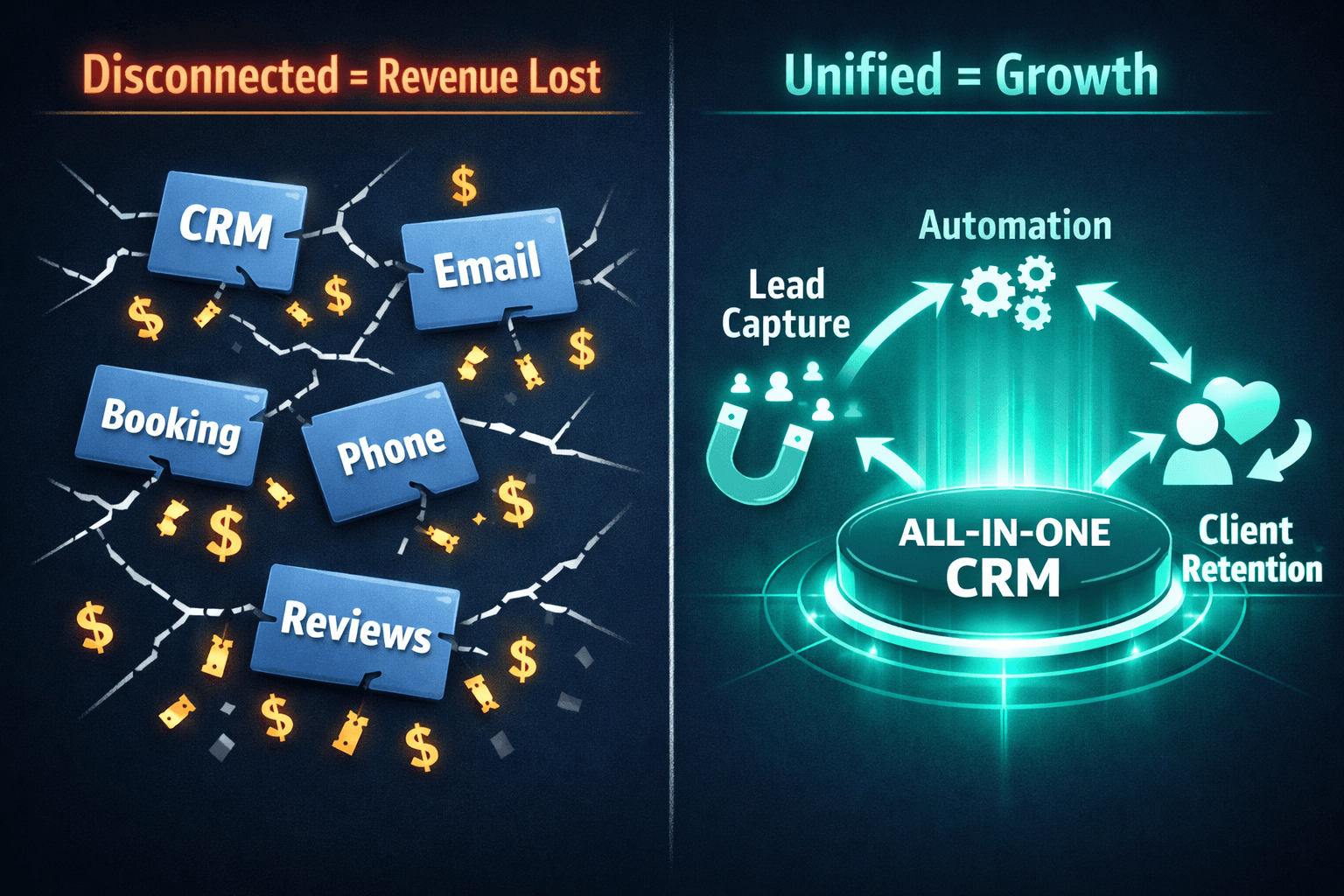
The all-in-one platform shift is the market-wide move away from stitched-together software stacks toward single, integrated systems that handle every core business function. It's happening now because the cost of fragmentation has finally become impossible to ignore.
Canva's recent acquisition of marketing automation platform Ortto and AI collaboration tool Simtheory — on top of earlier deals with Doohly, MagicBrief, Cavalry, and MangoAI — isn't a coincidence. It's a signal. The world's fastest-growing software companies are buying their way to consolidation because they know fragmented tools lose customers.
The Visible Costs: Subscriptions Add Up Fast
A typical stack for a local service business with 5–15 employees costs more than the sum of its subscription fees.
| Tool | Monthly Cost (Est.) | Function |
|---|---|---|
| CRM (e.g., HubSpot) | $50–$90 | Contact management |
| Email Marketing | $30–$80 | Campaigns & nurture |
| Booking Software | $16–$20 | Scheduling |
| Reputation Tool | $200–$400 | Reviews & messaging |
| Phone/VoIP system | $30–$60 | Call handling |
| Total | $356–$750/mo | 6+ Separate Logins |
The Invisible Costs: Where Revenue Actually Leaks
Data Blind Spots
Leads fall through the cracks when form fills don't automatically trigger CRM follow-ups.
Response Latency
Avg business takes 47 hours to respond. By then, the lead has booked with a competitor.
The real cost of fragmentation isn't what you pay for the tools. It's the revenue you never see because leads went cold while your team was switching tabs.
What Does a Unified Business Platform Actually Replace?
A true unified platform replaces every point solution in your stack with one connected system.
Why Marketing Automation Consolidation Is the Highest-ROI Move
Automation only works when it has complete data. When your CRM doesn't know what your email tool is doing, your automations fire blind. A lead who already booked gets a "don't forget to book" email.
Unified marketing automation ensures every trigger is accurate, outreach is never duplicated, and lead response happens in under 5 seconds. Cloudera's unified data platform delivered 38% faster performance — efficiency gains for small businesses show up in booked appointments.
How the All-in-One CRM Platform Solves Lead Response
A unified platform with built-in Voice AI changes the math entirely:
- Instant Entry: Lead submits form → Added to CRM immediately
- Instant Text: AI sends message within 5 seconds
- Instant Call: Voice AI qualifies and offers to book
- Instant Review: Automated request sent post-job
Reduce Software Costs by 50% or More
Stop paying for overlapping tools. Replace your fragmented stack with Hawk Guru.
View Consolidate Pricing →Frequently Asked Questions
How much can I save by consolidating?
Most local service businesses save $2,400–$7,200 annually by moving from 5-10 separate tools to a single unified platform.
Does consolidation improve conversion?
Yes. Response times drop to under 5 seconds, and no leads fall through the cracks between disconnected systems.
Is switching platforms difficult?
Migration typically takes 1–2 weeks, including contact import and setting up automated workflows.
References:
[1] 2026-04-08 Cloudera Advances Hybrid Data Platform - cloudera.com
[3] Shopify Developer Breaking Changes April 2026 - weaverse.io
[4] Spring '26 Release - Salesforce - salesforce.com
[5] Platform Engineering 2026 - growin.com