
AI Agents vs Traditional CRM: Why Enterprise Software Disruption Creates a Massive Opportunity for Small Businesses in 2026
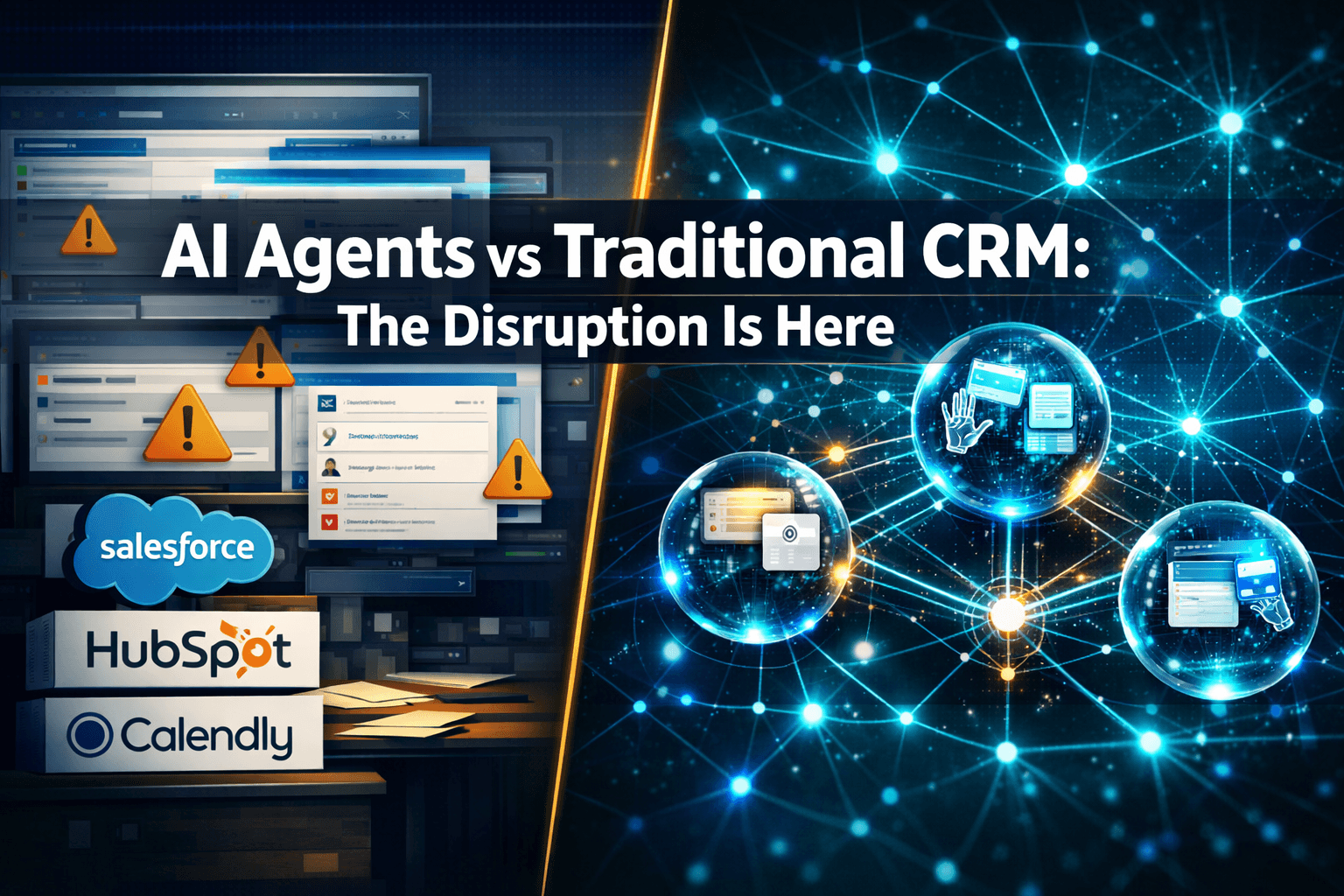
Quick Answer: Traditional CRM systems like Salesforce and HubSpot are losing ground fast. AI agents don't just improve on old software — they replace the need for it entirely. For small business owners in 2026, this shift means access to enterprise-grade automation at a fraction of the cost, but only if you act before your competitors do.
Key Takeaways
- $1 trillion in SaaS market value has been erased [2]
- Enterprise buyers are cutting software budgets by 30–40% [3]
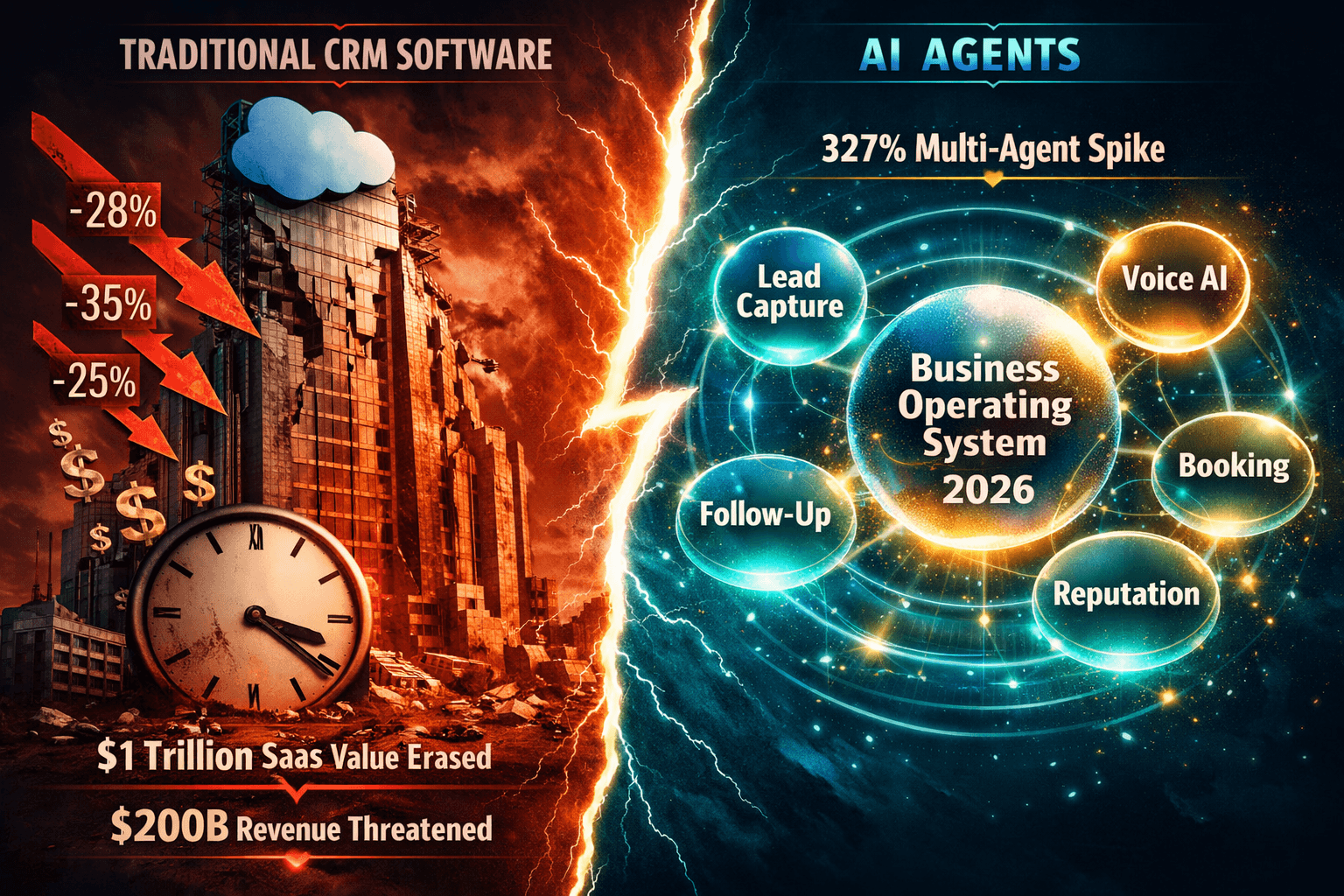
- Multi-agent system adoption spiked 327% in 2026 [2]
- AI agents replace the need for traditional CRM tools [1]
- Marketing automation dropped from $3,000/month to ~$200/month [3]
- Speed-to-lead under 5 seconds is now table stakes
- The new competitive moat is unified data context [5]
- Small businesses running 5+ apps are the biggest winners
What Is the "SaaSpocalypse" and Why Does It Matter for AI Agents CRM?
The SaaSpocalypse is the rapid, accelerating collapse of traditional SaaS software valuations driven by AI agent adoption. It matters because it signals a fundamental shift in how businesses buy and use software.
Approximately $1 trillion in SaaS market value has been wiped out as investors and enterprise buyers recognize that AI agents can execute the same workflows that traditional software merely organizes [2]. Salesforce is down 28% year-to-date. HubSpot is down 25% from SMB churn to AI-native CRMs. Atlassian recorded its first-ever enterprise seat decline and dropped 35% [1].
This isn't a market correction. It's a structural repricing of what software is worth when AI can do the work instead of just tracking it.
What changed: Traditional CRMs present data and wait for humans to act. AI agents take action autonomously — scanning leads, sending follow-ups, booking appointments, and resolving support tickets without a human ever touching a keyboard. When an AI agent handles 80%+ of tier-1 customer support tickets, the software underneath becomes overhead rather than infrastructure [1].
How Do AI Agents Actually Differ from Traditional CRM Systems?
Traditional CRMs organize work and display dashboards. AI agents own outcomes. That's the core distinction, and it changes everything about how a business operates.
| Feature | Traditional CRM | AI Agent Platform |
|---|---|---|
| Lead response time | Manual follow-up (hours/days) | Automated response in < 5 seconds |
| Availability | Business hours only | 24/7 autonomous operation |
| Data entry | Human-dependent | Self-populating via agent activity |
| Monthly cost | $3,000+ | ~$200 via AI agents [3] |
| Decision-making | Human interprets dashboard, then acts | Agent detects, simulates, and executes [4] |
Why Are Salesforce Alternatives Gaining Ground So Quickly?
Salesforce alternatives are winning because the cost-to-value equation has flipped. AI-native platforms now deliver better outcomes at 5–10% of the price.
Enterprise buyers are cutting software budgets by 30–40% as AI-powered alternatives produce superior results [3]. The $200 billion in annual SaaS revenue currently at risk reflects just how fast this repricing is happening [3].
What Does AI Business Automation Actually Look Like in Practice?
AI business automation in 2026 means a system that captures a lead, responds in under 5 seconds, qualifies the prospect, books the appointment, sends reminders, follows up post-service, and requests a review — with zero manual input at any step.
AI HVAC Practical Example:
- A prospect fills out a contact form at 11 PM on a Sunday
- The Voice AI Receptionist calls back within 5 seconds
- The agent qualifies the lead, captures job details, and books a service slot
- Automated reminders and review requests go out on autopilot
How Does Hawk Guru Function as a Business Operating System for 2026?
Hawk Guru is built as a Business Operating System — a single autonomous engine that replaces the fragmented stack of tools most small businesses are currently stitching together manually (Calendly, Mailchimp, Podium, etc.).
FAQ: AI Agents vs Traditional CRM
Can AI agents actually replace a full CRM system?
For most small and mid-sized businesses, yes. AI agents handle lead capture, follow-up, booking, and data management autonomously — tasks that traditionally required both a CRM platform and human staff to execute.
How much does switching from a traditional CRM to an AI-native platform save?
Enterprise-level marketing automation has dropped from $3,000/month to approximately $200/month via AI agent platforms [3]. For small businesses, consolidating 5+ tools into one platform typically saves $500–$1,500/month in direct subscription costs alone.
Is Salesforce going away?
Salesforce is not disappearing, but it is under significant pressure. The company launched Agentforce to compete with AI-native platforms [6]. For small businesses, Salesforce alternatives offer better value at far lower cost.
What is the 'SaaSpocalypse'?
The SaaSpocalypse refers to the rapid collapse of traditional SaaS software valuations as AI agents replace the need for standalone software tools. Approximately $1 trillion in SaaS market value has been erased as businesses shift to AI-native platforms [2].
Stop Paying for 10+ Disconnected Tools
Consolidate your entire tech stack into one autonomous system that works 24/7 for you.
Start Your Free Trial Today →References:
[1] Saaspocalypse Ai Agents Software Industry Analysis - digitalapplied.com
[2] Ai Agents Enterprise Saas Disruption - builtin.com
[3] The Saaspocalypse Ai Agents Are Eating Enterprise Software - techbuzz.ai
[4] Why Ai Agents Will Replace Enterprise Software - etedge-insights.com
[5] Enterprise Software Faces Shift As Agents Replace Apps - businessinsider.com